Our company has over ten years of experience in the research and development and production of plastic quick connectors. We are specialized in manufacturing various quick connectors for automotive, motorcycle, and energy storage pipes. Our company focuses on the connection and dust protection of automotive fuel lines, urea, steam, hydraulic systems, brake systems (low pressure), hydraulic power steering systems, power battery cooling systems, intake systems, exhaust systems, and auxiliary systems.
Our main products include quick connectors, fuel line assemblies, liquid cooling line assemblies, urea line assemblies, breather pipe assemblies, vacuum pipe assemblies, and pipe dust covers. Our company also offers sample processing and OEM services.
Know About Our Quick Connectors
Quick Connector Structure
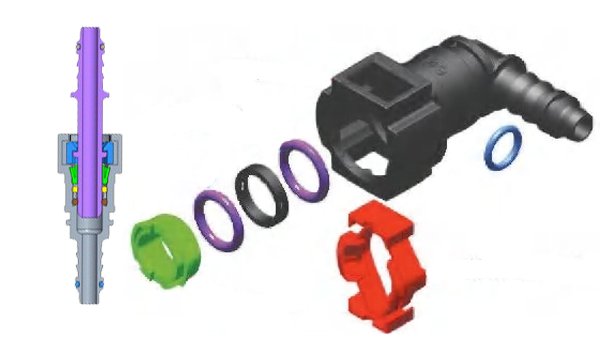
The female connector consists of a connector housing, inner O-ring, outer O-ring, isolation ring, outer retaining ring, and self-locking clip. When a male connector is inserted into the connector, the self-locking clip, due to its elasticity, works with the snap-fit fastener to connect the two connectors together. Pulling it back ensures proper installation; this is how the quick-connect connector functions. During maintenance, disassembly is simple: first push in the male connector, then press the latch buttons at both ends of the self-locking clip to expand the middle of the clip, allowing the male connector to be easily pulled out. Lubricate with lubricant before reconnecting.
Advantage of Plastic Quick Connectors
Plastic quick connetors offer the advantages of lightweight and corrosion resistance, helping to meet environmental/emission requirements.
The parts are compact and small, which make them very easy to use.
Reduced assembly time increases productivity: no tools are required for disconnecting in the after-sales market.
There is the widest range of quick connectors for fuel lines and all automotive circuits, available in various angles, shapes, and diameters.
Multifunctional quick connectors: can integrate various functions, such as shut-off valves, control valves, check valves, pressure regulating valves, and pressure test valves.
All connectors meet specific cleanliness standards and feature anti-misassembly devices.
Operating Instructions
Connection of the quick connectors
Male ends checking: The male connector must meet the specifications outlined in the document, ensuring it is free of dust and damage, in order to guarantee assembly quality.
Tools and material: Prepare the necessary assembly tools, such as manual crimping tools, and lubricants such as engine oil or silicone grease.
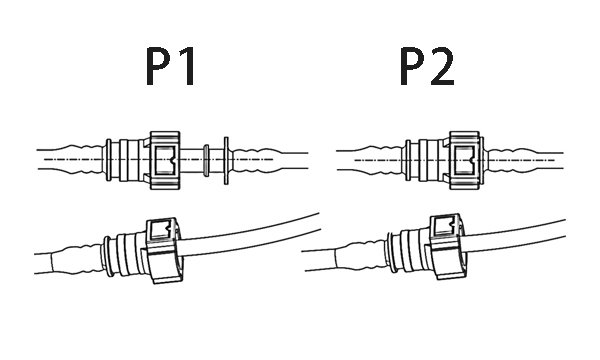
Connection: The male connector should be inserted into the female connector along the axis of the joint to prevent axial deviation and displacement of the sealing ring, ensuring a tight fit.
Checking: Manually insert the male connector all the way in until you hear a “click” sound, confirming that it is properly connected; gently push and pull the quick connector to check if it is fully connected.
Disconnection of the quick connectors
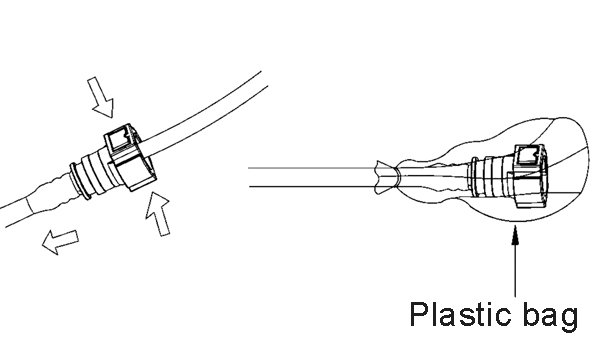
The quick connector should be disassembled following these steps: Before disassembly, check if there is any dirt or other foreign matter near the fuel pipe of the quick connector. If so, clean it thoroughly. Disconnect the quick connector by hand; When the quick connector and fuel pipe are tightly connected, hold the fuel pipe with one hand, and push and pull the quick connector with the other hand while pressing the double-sided buttons on the connector, then pull it out. Do not use any tools during this process; If there is any dirt or other foreign matter on the sealing surface of the disconnected fuel pipe connector, it should be cleaned thoroughly; The disconnected fuel pipe and quick connector should not be damaged, and should be wrapped with a plastic bag to prevent any foreign matter from entering the pipe.